Contents
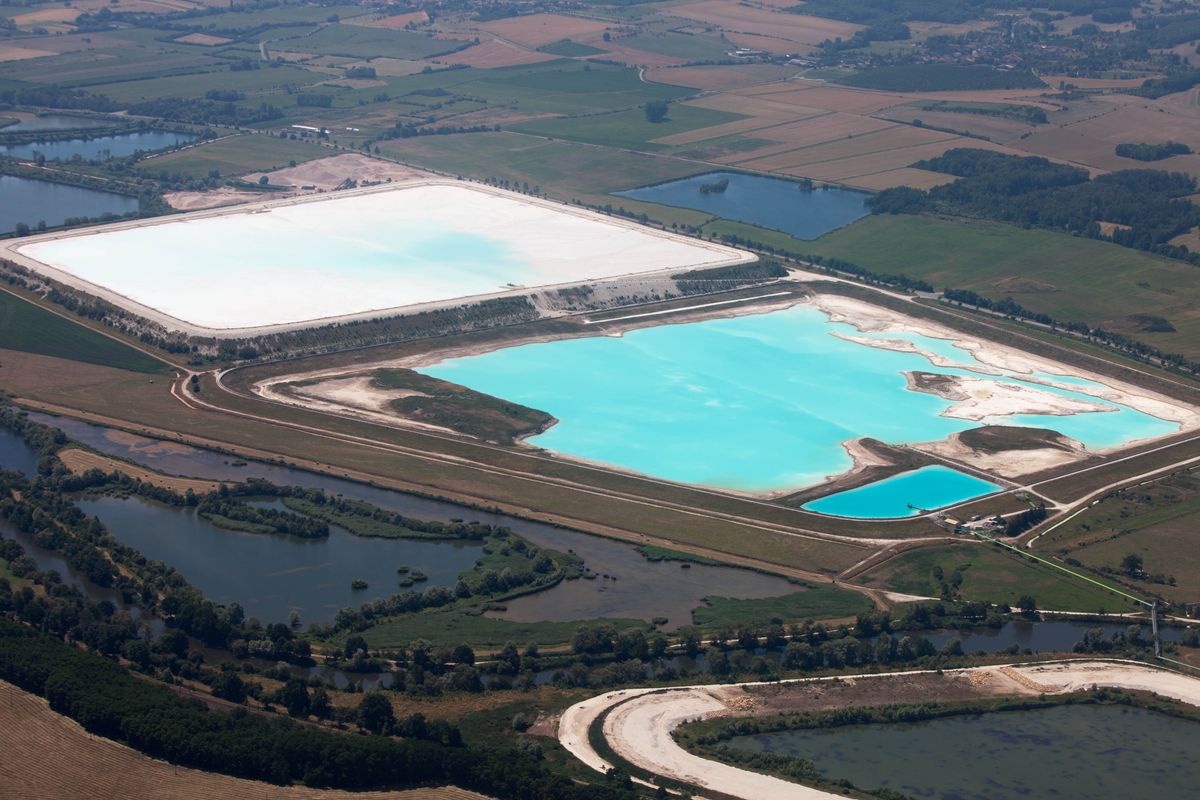
- Most synthetic soda ash is made by the Solvay ammonia-soda process from salt and limestone.
- The combined process, common in China, yields ammonium chloride — a fertiliser — instead of calcium chloride waste.
- Some countries produce soda ash from the natural mineral trona.
- Dense ash is made from light ash via the monohydrate and recalcination.
Soda ash is one of the oldest products of the chemical industry. The production route affects cost, by-products and sometimes impurities in the finished product, so buyers benefit from knowing where it comes from.
The Solvay (ammonia-soda) process
Developed by Ernest Solvay in the 1860s, it remains the main route to synthetic soda ash. The raw materials are salt, limestone and ammonia, which is almost entirely recycled.
- 01
Brine purification
Calcium and magnesium salts are removed from salt brine.
- 02
Ammoniation
The brine is saturated with ammonia.
- 03
Carbonation
Carbon dioxide is passed through the ammoniated brine; sodium bicarbonate NaHCO₃ precipitates.
- 04
Filtration
Bicarbonate crystals are separated from the ammonium chloride solution.
- 05
Calcination
The bicarbonate is calcined: 2NaHCO₃ → Na₂CO₃ + H₂O + CO₂. The CO₂ goes back to carbonation.
- 06
Ammonia recovery
The ammonium chloride solution is treated with milk of lime and ammonia is recycled; the waste is calcium chloride solution.
Carbon dioxide and lime come from burning limestone: CaCO₃ → CaO + CO₂. Soda plants are therefore usually built near salt and limestone deposits.
The combined process
In the combined process (developed by Chinese chemist Hou Debang), ammonia is not recovered with lime: ammonium chloride NH₄Cl is crystallised from the solution and sold as a nitrogen fertiliser. There is no calcium chloride waste and more useful product. The process is widely used in China, the world's largest soda ash producer.
Natural soda
Soda ash can be made from the mineral trona (Na₂CO₃·NaHCO₃·2H₂O) and soda brines: the ore is dissolved, purified and calcined. The largest trona deposits are in the USA; natural soda is also produced in Turkey, China and other countries. Costs are usually lower and there is less waste.
The routes compared
| Solvay | Combined | Natural soda | |
|---|---|---|---|
| Raw materials | salt, limestone, ammonia | salt, ammonia, CO₂ | trona, soda brines |
| By-product | calcium chloride (waste) | ammonium chloride (fertiliser) | minimal |
| Where common | Europe, Russia, many countries | China | USA, Turkey, China |
| Feature | proven technology | two saleable products | low cost |
How dense soda ash is made
All routes first produce light ash. To make dense ash, light ash is moistened to form the monohydrate Na₂CO₃·H₂O and then calcined again. Particles become larger and denser: bulk density rises from about 0.5–0.6 to 0.9–1.1 t/m³.
Soda ash in China and Qinghai
China produces more soda ash than any other country and uses all three routes. In Qinghai province, soda plants draw on salt from the salt lakes of the Qaidam Basin and on local limestone.
The production route is stated in the producer's documents. What matters to the buyer are the actual lot values in the TDS and COA: Na₂CO₃ content, chlorides, iron, insoluble matter.
Frequently asked questions
What is soda ash made from?
Synthetic soda ash is made from salt and limestone (Solvay) or from salt, ammonia and CO₂ (combined process); natural soda ash from the mineral trona.
Why is it called calcined soda?
Because in the final stage sodium bicarbonate is calcined (roasted) to give anhydrous sodium carbonate.
Does the production route affect quality?
The route can affect certain impurities, but quality is defined by actual lot values. Compare soda ash by TDS and COA.
How is dense ash produced differently?
It is made from light ash via the monohydrate and recalcination, so it is denser and usually costs more.